Memory and the archive have been both the subject of reflection and the driving force behind Astrid Jahnsen’s most recent artistic projects. A claim against oblivion, the recovery of memory, and the construction of a new relationship with the past have marked a trajectory that began as a simple search for what was hidden in documents and has become a questioning of the documents themselves.
In Reencuentro, a set of negatives purchased almost by chance online led her to reconstruct the history of an emblematic neighborhood in the Rímac before it virtually disappeared with the construction of the Santa Rosa bridge in the early 1960s. In Revelados, Astrid brought a group of life-size effigies of figures photographed by Eugenio Courret into the streets of downtown Lima, as a protest against forgetting. And in Fotografía Central, she recorded the interiors of Courret’s studio as they exist today, using the old wet collodion technique—the same one Courret himself used for his first photographs in Peru—to establish a metaphorical bridge between a lost past and the present.
Over time, however, her gaze has become more precise and has begun to see beyond. While any old photograph or book can serve as a starting point for reconstructing the past, that reconstruction can take many forms. Depending on the approach and the tools used to extract the past from documents, what they reveal will be different.
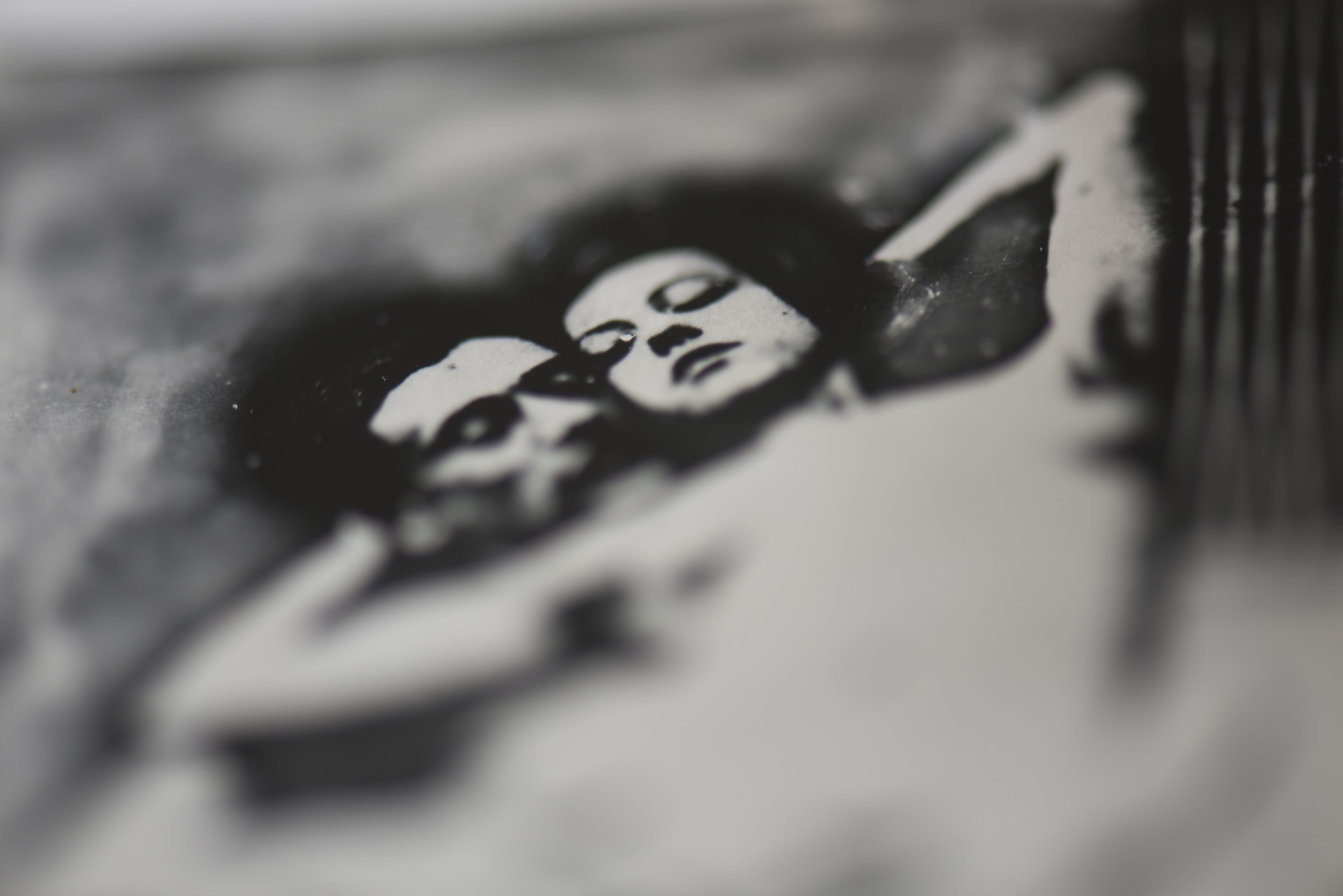
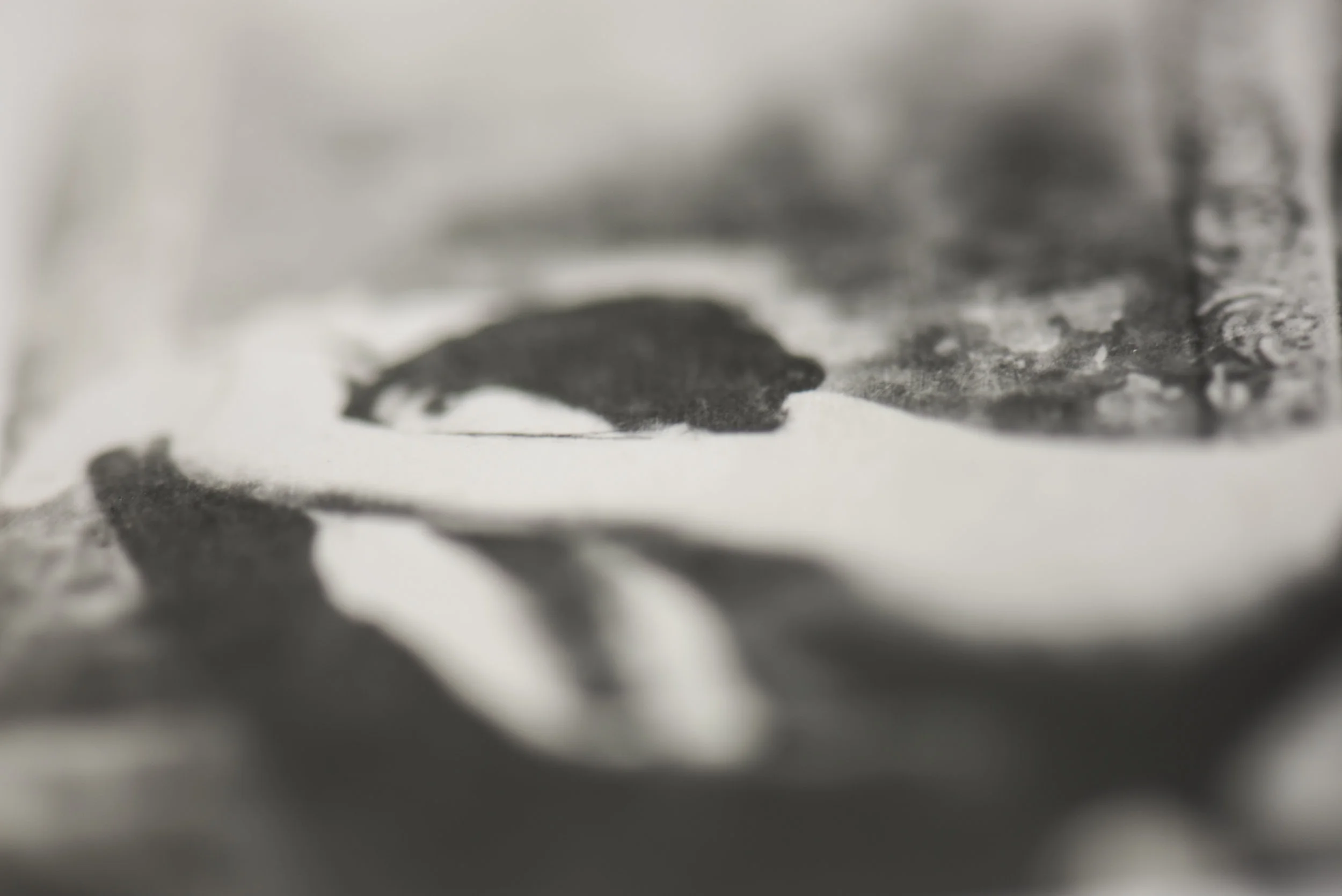
This is something Astrid began to discover while re-photographing old anonymous images bought by weight at flea markets, or the illustrations found in outdated encyclopedias from the last century. Shot with a macro lens, entire sections of these images become blurred, while only certain details remain in focus. This effect not only allows her to select specific aspects of the photographs—the figures in the background, a sign that barely forms part of the scene—but, when enlarged, the macro also reveals the grain of the photographic paper or the dots of the printing matrix: in other words, the structure that makes up the image as a physical object, a set of points that our perception unifies into meaning.
The exhibition On Your Knees emerges from the purchase of 82 pornographic booklets from the 1960s. Handmade—stapled and typed—these explicit narratives, with titles such as “The Excitements of the Flesh,” “The Unattainable Miss Vanessa,” or “Slaves of Sex,” are illustrated with erotic photographs from various sources. This material, which in some ways recalls the little booklets that “The Poet” sold to his classmates in The Time of the Hero, becomes an object of scrutiny for the artist, who, armed with a macro lens, explores and reproduces it with a certain fascination.
Her images, which highlight only certain details while leaving the rest blurred, gradually become a visual metaphor for the way Jahnsen begins to understand the material she is working with. Her way of seeing through the macro becomes a metaphor for an evident truth that often goes unnoticed: if you look closely enough, you discover how things are made. Taken to a conceptual level, this visual tool reveals the ideological structure of documents which, when examined closely—with the appropriate critical tools—expose their seams: the prejudices, preferences, distortions, and injustices inherent in any perspective begin to surface.
And this is precisely the result of the artist’s scrutiny, one that, in her own words, leads her to an unavoidable conclusion: “I discover that the pornographic photographs of that time, the photographs in newspapers and magazines, the photographs in encyclopedias... were all taken from a male body. And I begin to remember every book, every text, every image before my eyes as a child—in school, in the library, in the newspaper that arrived at my home, in the unquestionable encyclopedia... all from a male point of view.”
In On Your Knees, in particular, what Jahnsen’s gaze reveals is the construction of desire and of what is considered sexually desirable through the male gaze, and certainly in the absence—if not to the detriment—of the female one. These pornographic booklets expose the subjugation imposed on women by the male gaze: placing them on their knees, as the phrase from one of the stories—chosen by Astrid as the title of the series—so clearly expresses.
But—let us be clear—we are not speaking here of a power that operates only within explicitly sexual domains. What Jahnsen reveals is a power that operates across all spheres; what she teaches us to see is that any document, when properly examined, will reveal the role that women have (not) played—and in many cases still do not play—in historical narratives or in their participation in science, art, or politics, to name just a few examples. On Your Knees is only a specific case that allows a much broader truth to be seen. Now that our eyes have been opened, it is up to us to truly look.
CARLO TRIVELLI